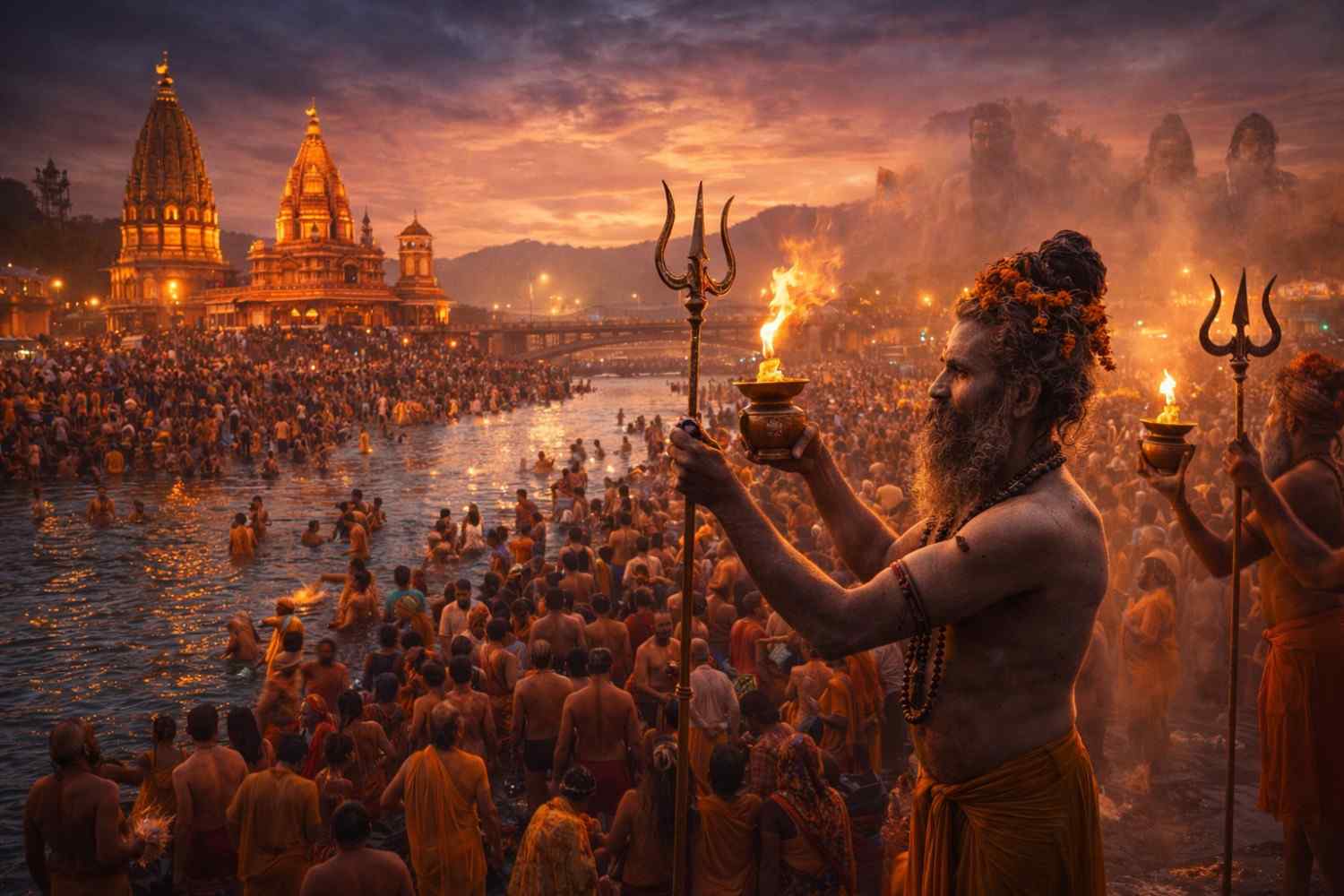
Whenever people hear “Kumbh Mela,” they usually think of huge crowds and holy dips. But when I once spoke to a shopkeeper near Ramkund in Nashik, he said something simple:
“People don’t come here only for bathing. They come here to feel lighter.”
That sentence stayed with me.
So if you’re wondering why Nashik Kumbh Mela is held, the answer is not just mythological. It is historical, spiritual, and deeply emotional for millions of people.
Let’s understand it properly — without exaggeration and without confusion.
The Myth That Started It All
The origin of Nashik Kumbh Mela goes back to the ancient story of Samudra Manthan — the churning of the ocean.
As the story goes, gods and demons churned the ocean to obtain amrit, the nectar of immortality. When the pot of nectar appeared, a struggle followed. During that chase, a few drops are believed to have fallen on four places in India — Prayagraj, Haridwar, Ujjain, and Nashik.
In Nashik, it is believed that the nectar touched the banks of the Godavari River.
Now, whether someone sees this as literal truth or symbolic storytelling is a personal matter. What matters is that this belief has shaped tradition for centuries. Faith, in many ways, survives because people keep practicing it.
Read This Also: Holika Dahan 2026: Date, Muhurat, Puja Vidhi & Story
Why Nashik? What Makes It Special?
Nashik is not just any city added to the list.
The Kumbh here is closely connected to the Godavari River, which many call the “Ganga of the South.” It is also linked to Trimbakeshwar Temple, one of the twelve Jyotirlingas dedicated to Lord Shiva.
When you walk through Trimbak during Kumbh time, you can feel the difference. The town doesn’t feel like it is hosting an event. It feels like it is fulfilling a responsibility.
The festival here is sometimes called Simhastha Kumbh because it takes place when Jupiter enters the zodiac sign Leo (Simha). This astrological timing is not random — it has been followed for generations.
Read This Also: What Is Simhastha Kumbh? History, Meaning & Spiritual Significance Explained
It’s Not Just a Bath — It’s a Reset
Many first-time visitors think Kumbh Mela is simply about taking a dip in the river.
But when I’ve asked pilgrims why they came, their answers are usually personal:
-
“For my parents’ peace.”
-
“For a fresh start.”
-
“To let go of something heavy.”
The holy dip, called Shahi Snan, is symbolic. It represents cleansing — not just of the body, but of guilt, regret, and emotional burdens.
That is why Nashik Kumbh Mela is held. Not just because of a legend, but because people believe in renewal.
How the Festival Actually Unfolds
Here’s what usually happens during Nashik Kumbh:
| Ritual | Why It Matters |
|---|---|
| Shahi Snan | Marks spiritually powerful bathing days |
| Akhara Processions | Shows the presence of different monastic groups |
| Religious Discourses | Teachings from saints and scholars |
| Charity & Food Distribution | Acts of service and sharing |
The Akhara processions are something many people don’t fully understand. These are ancient monastic orders. Their entry into the river follows strict order and discipline. It’s not random; it’s tradition preserved carefully.
The Deeper Spiritual Meaning
If I had to explain the spiritual significance in simple words, I’d say this:
Nashik Kumbh Mela is about continuity.
Grandparents bring grandchildren. Stories are repeated. Rituals are followed exactly as they were decades ago.
In a world where everything changes quickly, this continuity gives people comfort.
It also reinforces three key ideas:
-
Life is temporary.
-
Actions matter.
-
Community gives strength.
Read This Also: Genetic Testing in IVF (PGT-A, PGT-M): Full Guide Before Embryo Transfer
Common Misunderstandings About Nashik Kumbh
Let me clear a few things people often assume:
1. “It’s just blind faith.”
For many, it is structured spiritual practice, not blind following.
2. “It’s unsafe because of crowds.”
Large crowds require planning, yes. But administration prepares for years in advance.
3. “It’s only for religious extremists.”
That’s not accurate. Families, students, elderly couples — all kinds of people attend.
If You’re Planning to Visit: A Simple Checklist
If you’re considering going, here’s what actually helps:
-
Check official bathing dates.
-
Book stay well in advance.
-
Carry basic medical supplies.
-
Avoid peak hours if traveling with elders.
-
Follow local announcements.
Preparation makes the experience smoother.
Why Nashik Kumbh Still Matters Today
Some people ask whether such ancient gatherings are still relevant.
From what I’ve observed, they are — not because of mythology alone, but because they create shared experience.
In cities, people often live isolated lives. At Kumbh, strangers talk. Food is shared. Stories are exchanged.
That sense of belonging is powerful.
Final Thoughts
Nashik Kumbh Mela is held because of a centuries-old belief connected to the nectar of immortality. But it continues because people still find meaning in it.
It is part mythology, part astrology, part history — and deeply human at its core.
You don’t have to agree with every ritual to understand its importance. But once you see the devotion in people’s eyes at Ramkund during sunrise, you begin to understand why this gathering has survived for so long.
FAQS
1. Why Nashik Kumbh Mela Is Held?
Why Nashik Kumbh Mela Is Held is linked to the Samudra Manthan legend. It is believed that drops of nectar fell near the Godavari River, making Nashik sacred.
2. How often is Nashik Kumbh Mela held?
To understand Why Nashik Kumbh Mela Is Held, it is important to know that it takes place every 12 years based on astrological alignment of Jupiter.
3. What is Simhastha Kumbh in Nashik?
Why Nashik Kumbh Mela Is Held is connected to Jupiter entering Leo (Simha), which is why the event is called Simhastha Kumbh.
4. Is Nashik Kumbh Mela only about holy bathing?
No. Why Nashik Kumbh Mela Is Held goes beyond bathing. It represents spiritual renewal, tradition, and community bonding.
5. What makes Nashik different from other Kumbh locations?
Why Nashik Kumbh Mela Is Held is unique due to its connection with the Godavari River and Trimbakeshwar Jyotirlinga.